




Artificial intelligence is being adopted rapidly across industries, workplaces and in personal use, with an estimated 1 in 4 Americans using it regularly, but there is a knowledge gap.
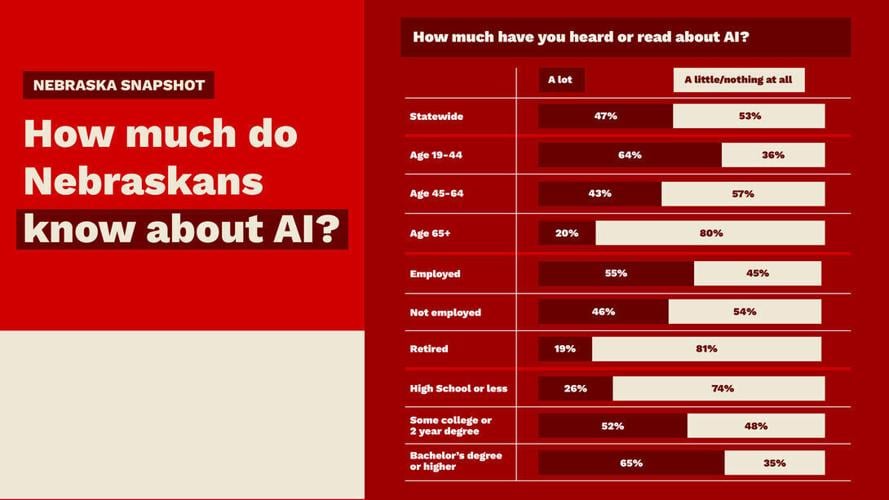
The new Nebraska Snapshot shows that only about half, or 47%, of Nebraskans surveyed say they have read or heard a lot about artificial intelligence, with 53% saying they have read or heard little or nothing at all. Disparities in knowledge are larger when looking at age, employment, education and income level.
Based on data from the Nebraska Annual Social Indicators Survey from the University of Nebraska–Lincoln’s Bureau of Sociological Research, the Nebraska Snapshot reveals that more educated, high-income and younger Nebraskans have learned more about AI.
People are also reading…
Those with a bachelor’s degree or higher are more likely to have read or heard about AI, with 65% of respondents reporting they have heard or read a lot about it. Meanwhile, only 26% of Nebraskans surveyed with a high school degree or less report the same. Those with some college or a two-year degree fall in the middle at 52%.
Similarly, 61% of respondents making $100,000 or more a year have heard or read a lot about AI, but only 38% of those making less than $50,000 and 39% of those making $50,000 to $100,000 said the same.
Nebraskans aged 19-44 are much more aware of AI, with 64% of respondents reporting they have read or heard a lot, but only 20% of those 65 and up said the same. Forty-three percent of those 45-64 said they have read or heard a lot about AI.
Nebraskans’ encounters with AI information line up with peers across the United States. According to Pew Research Center, 47% of Americans said they have read or heard a lot about artificial intelligence, while 48% stated they had read or heard a little, and only 5% said they had heard or read nothing about AI.
Pew surveys also showed the share of Americans who are more concerned than excited about artificial intelligence has grown since 2021, when 37% shared the sentiment, in contrast with 50% in 2026. Generally, Americans view AI more favorably for its potential in medical care but are less favorable toward its use in news gathering, elections and personal relationships. A majority of American workers surveyed (65%) still say they don’t use AI much or at all for their jobs.
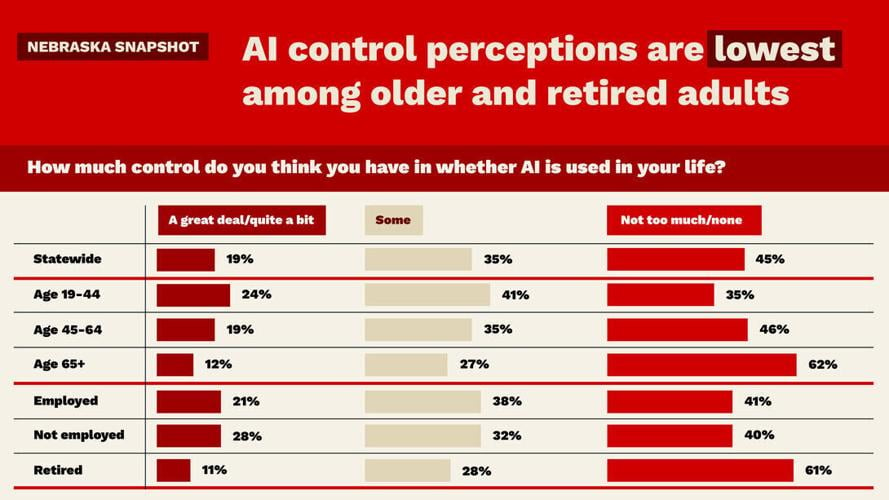
Nebraskans’ perception of control over artificial intelligence in their daily lives is similar. Overall, 45% of Nebraskans surveyed said they have not too much or no control over artificial intelligence in their life, while 35% said they have some control, and only 19% said they have a great deal or quite a bit of control in whether AI is used in their lives.
The largest discrepancies in perceptions of control were among older and retired Nebraskans. Most respondents 65 and up, or 62%, feel they have little or no control in whether AI is used in their life, while only 35% of Nebraskans 19-44 said the same. Most retired Nebraskans surveyed, 61%, also said they have not too much or no control over AI in their lives.
The Nebraska Annual Social Indicators Survey is used by researchers, state entities and policymakers but also includes a core questionnaire that delves into demographics, quality of life measures, educational attainment and community satisfaction, among other variables. These core questions will inform most of the Nebraska Snapshot series. This is the first time the survey has included questions about artificial intelligence.


